 A Comprehensive Guide to Knee Rehabilitation and Strength Training
Knee rehabilitation and strength training can help restore movement, rebuild confidence, and make everyday activities feel more manageable. However, effective rehabilitation involves more than performing a random collection of knee exercises. It requires understanding why the knee feels painful or weak, selecting movements appropriate for the underlying problem, and increasing difficulty gradually without repeatedly aggravating the joint.
In our analysis of knee rehabilitation methods, one pattern consistently stands out: people often focus exclusively on the painful area while overlooking the muscles, nerves, and movement patterns that control the knee. The quadriceps, hamstrings, calves, gluteal muscles, femoral nerve, kneecap, and surrounding connective tissues all influence how the joint handles pressure.
This comprehensive guide explains the foundations of knee rehabilitation and strength training, including low-impact exercise, quadriceps activation, mobility work, patellofemoral pain management, electrotherapy, and realistic at-home recovery strategies.
Medical disclaimer: This guide provides general educational information and is not a diagnosis or individualized rehabilitation plan. Knee pain can result from arthritis, ligament injuries, meniscus tears, fractures, infections, nerve disorders, blood clots, and other conditions. Consult a qualified healthcare professional before beginning a new exercise program, especially following an injury or operation.
What Is Knee Rehabilitation and Strength Training?
Knee rehabilitation is a structured process for improving joint motion, muscle function, balance, and the ability to perform daily activities. Strength training is one component of that process, but it should not be treated as the entire solution.
A well-designed rehabilitation plan may address:
- Knee flexion and extension range of motion
- Quadriceps activation and endurance
- Hamstring, calf, and hip strength
- Patellar tracking and lower-limb alignment
- Balance and joint-position awareness
- Walking, stair climbing, sitting, and standing
- Gradual tolerance to resistance and impact
- Fear of movement following pain or injury
The purpose is not simply to make the knee work harder. It is to help the entire lower limb distribute force more efficiently. This distinction matters because an exercise can strengthen a muscle while still being poorly suited to a person’s current symptoms or stage of recovery.
Why Knees Become Painful, Stiff, or Weak
Knee symptoms do not always have a single cause. Two people can report similar pain while needing very different rehabilitation plans. One may have osteoarthritis and reduced activity tolerance, while another may have irritation around the kneecap, a tendon problem, or weakness after surgery.
Loss of Quadriceps Strength
The quadriceps straighten the knee, help control the kneecap, absorb force during walking, and support the body when descending stairs. Pain, swelling, injury, and surgery can interfere with the nervous system’s ability to recruit these muscles effectively.
This response is sometimes described as arthrogenic muscle inhibition. The muscle may be physically present, yet the nervous system does not activate it normally. That helps explain why simply telling someone to “strengthen the quads” may not solve the problem. Early rehabilitation may need to emphasize gentle contractions, controlled range of motion, and motor retraining before heavier resistance is introduced.
Changes in Joint Mobility
Stiffness can develop when a person stops moving the knee through a comfortable range. Swelling, protective muscle tension, scar tissue, and prolonged sitting may contribute. Reduced ankle or hip mobility can also change how force travels through the knee.
Gentle movement circulates synovial fluid within the joint and can temporarily reduce the feeling of stiffness. Movement does not regrow missing cartilage, but appropriately dosed activity may help preserve function and improve the capacity of the tissues surrounding the knee.
Patellofemoral Pressure
Patellofemoral pain is commonly felt around or behind the kneecap. Activities such as squatting, using stairs, running, or sitting with bent knees may increase symptoms because they alter the forces between the patella and femur.
This does not automatically mean those movements must be avoided forever. Rehabilitation often involves adjusting knee depth, resistance, volume, and technique while strengthening the quadriceps and hip muscles. Our goal is to find a tolerable starting point and then expand what the knee can handle.
Nerve-Related Weakness or Altered Sensation
The femoral nerve supplies motor signals to the quadriceps and carries sensory information from parts of the thigh and lower leg. A serious femoral nerve problem can cause weakness when straightening the knee, altered sensation, buckling, or difficulty climbing stairs.
Not every weak quadriceps muscle indicates femoral nerve damage. Pain-related inhibition, inactivity, swelling, and fear of movement are more common explanations. Persistent numbness, progressive weakness, or unexplained knee buckling deserves professional assessment rather than self-treatment alone.
For a closer look at the anatomy, read what the femoral nerve is and how it controls the leg.
The Main Stages of Knee Rehabilitation
Although individual plans differ, knee rehabilitation and strength training generally progress through several overlapping stages. Progress should be based on symptoms and function rather than an arbitrary calendar.
Stage 1: Calm Irritation and Restore Basic Motion
The initial goal is to identify movements the knee can tolerate. This may include short walks, heel slides, gentle knee extensions, ankle pumps, or comfortable stationary cycling. Following surgery or a significant injury, the surgeon’s restrictions take priority over general exercise advice.
Complete rest is not always the best response to ordinary stiffness, but repeatedly forcing a painful or swollen knee is not productive either. A useful starting dose should leave symptoms stable or only mildly elevated.
Stage 2: Re-establish Muscle Activation
Once basic motion is tolerated, rehabilitation commonly focuses on helping the quadriceps contract effectively. Examples may include quadriceps sets, straight-leg raises, short-arc knee extensions, or seated knee extensions through a comfortable range.
The correct exercise depends on the condition. A straight-leg raise may be inappropriate if a person cannot keep the knee straight, experiences significant pain, or has postoperative restrictions.
Stage 3: Build Strength and Movement Control
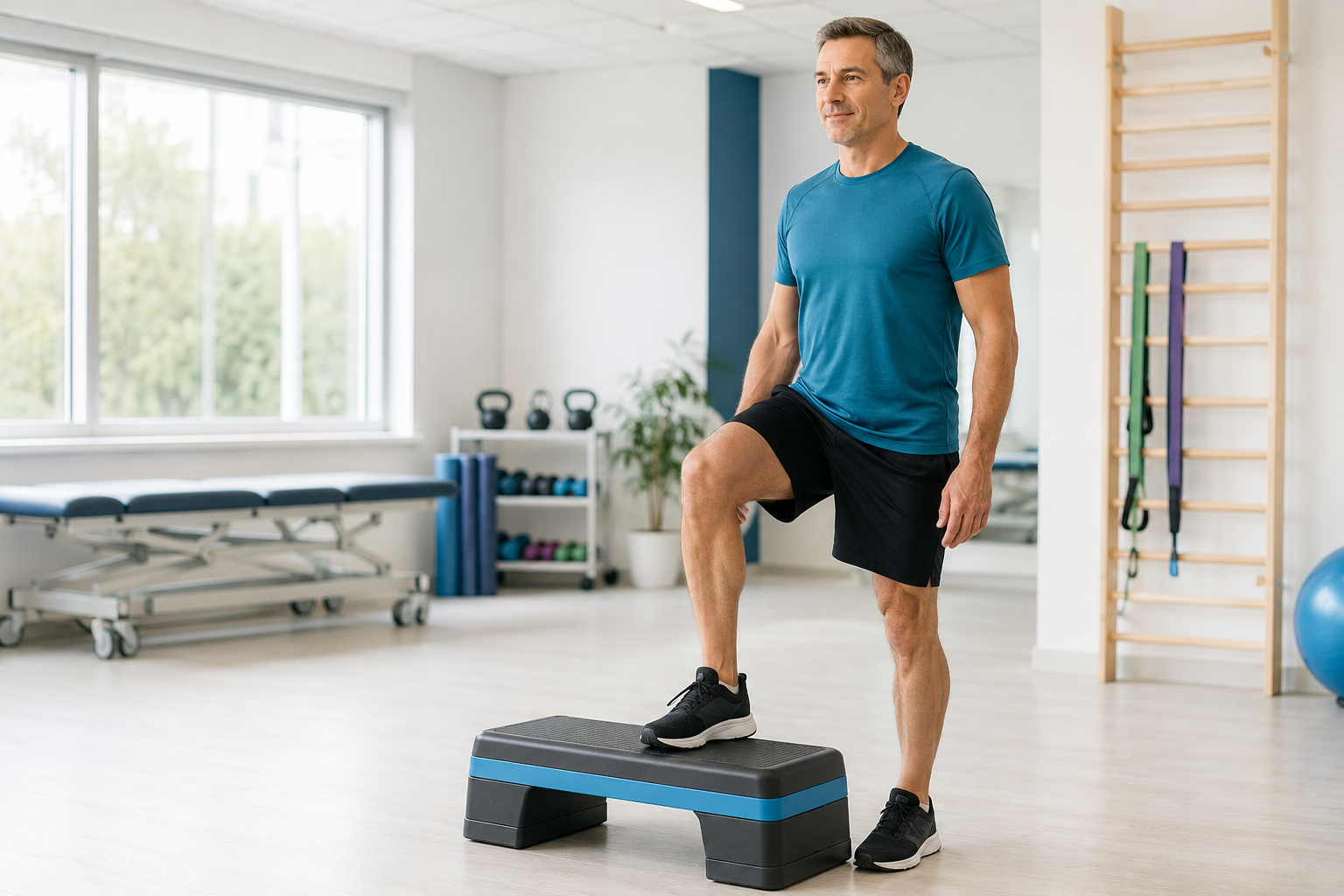
This phase introduces progressively more demanding exercises such as sit-to-stands, partial squats, step-ups, bridges, calf raises, and supported balance drills. The aim is to make the knee more capable during real activities rather than chasing fatigue for its own sake.
Stage 4: Restore Everyday or Recreational Function
Later rehabilitation may include deeper squats, higher steps, single-leg work, faster walking, direction changes, or sport-specific drills. These movements should be earned through gradual progression. A person recovering enough strength to walk around the house may not yet be ready for running, jumping, or abrupt pivots.
| Rehabilitation stage | Primary objective | Possible movement examples |
|---|---|---|
| Early | Reduce irritation and restore comfortable motion | Heel slides, ankle pumps, short walks |
| Activation | Improve muscle recruitment | Quadriceps sets, supported leg raises |
| Strength | Increase capacity and control | Sit-to-stands, bridges, partial squats |
| Functional | Prepare for daily or recreational demands | Step-ups, loaded carries, advanced balance work |
Low-Impact Knee Strengthening Exercises
Low-impact does not mean ineffective. It means the movement limits abrupt landing forces while still challenging muscles and joint control. This can be particularly useful for beginners, older adults, or people returning to activity after a painful period.
Common options include:
- Quadriceps sets: Tighten the front thigh while keeping the leg supported.
- Heel slides: Bend and straighten the knee within a comfortable range.
- Sit-to-stands: Rise from a stable chair using a controlled tempo.
- Supported mini-squats: Use a counter or sturdy chair for balance.
- Glute bridges: Strengthen the hips without requiring deep knee flexion.
- Standing hamstring curls: Bend the knee slowly while holding a stable surface.
- Calf raises: Strengthen the lower leg and support walking mechanics.
- Low step-ups: Practice controlled stair-like movement.
- Stationary cycling: Encourage repetitive motion with adjustable resistance.
- Pool exercise: Use water buoyancy to reduce weight-bearing demands.
Beginners can explore our detailed guide to the best low-impact knee exercises. People without weights can also use these methods for strengthening the knees using body weight and household support.
How Hard Should Knee Exercises Feel?
Knee rehabilitation and strength training should create an appropriate challenge without producing a major setback. Pain is personal, and no single number works for everyone. A practical approach is to monitor symptoms during the exercise, later that day, and the following morning.
Mild discomfort may be acceptable for some chronic knee conditions when it settles promptly and does not alter walking. The exercise dose may be too high when pain continues escalating, swelling noticeably increases, sleep is disrupted, or function is worse the next day.
If symptoms flare, consider changing one variable at a time:
- Reduce the depth or range of the movement.
- Perform fewer repetitions or sets.
- Use less resistance.
- Slow the pace and improve control.
- Add support from a rail, chair, or countertop.
- Allow more recovery time before repeating the session.
Key takeaway: A successful session is not necessarily the hardest one you can finish. It is a session that creates enough stimulus to encourage adaptation while allowing you to recover and continue progressing.
A Simple At-Home Knee Rehabilitation Framework
The following framework illustrates how a general session might be organized. It is not a prescription for a specific injury or surgical procedure.
1. Gentle Warm-Up
Begin with five to ten minutes of comfortable walking, easy cycling, or slow knee bending and straightening. A warm-up gives you time to assess how the knee feels before adding resistance.
2. Mobility Work
Choose one or two movements that address a genuine limitation. This might include heel slides for knee flexion or a supported knee-straightening position. Avoid aggressively forcing the joint into pain.
3. Muscle Activation
Use a low-load movement such as a quadriceps set or controlled leg raise. Focus on the quality of contraction rather than rushing through repetitions.
4. Strength Exercises
Select two to four exercises covering more than one muscle group. A session might include sit-to-stands, bridges, calf raises, and a supported step exercise. Start with a manageable volume and progress one variable at a time.
5. Balance or Functional Practice
Depending on ability, practice supported single-leg balance, controlled weight shifting, or stair technique. Always use a stable support if falling is a concern.
6. Reassess
Notice whether the knee feels warmer, looser, fatigued, unstable, or increasingly painful. Record the exercises and the next-day response. This simple feedback makes future sessions easier to adjust.
How to Progress Knee Strength Training Safely
Muscles and connective tissues need progressively greater challenges to adapt. However, adding resistance too quickly can irritate a knee that has not yet developed sufficient capacity.
Progression can involve:
- Adding repetitions
- Adding another set
- Increasing resistance slightly
- Moving through a larger comfortable range
- Slowing the lowering phase
- Reducing hand support
- Increasing step height
- Practicing a more demanding variation
A common mistake is changing several variables at once. If you increase the resistance, range, and total volume during the same session, it becomes difficult to determine what caused a flare-up. Small, trackable changes are usually easier to manage.
Femoral Nerve Activation and Quadriceps Weakness
The relationship between the nervous system and quadriceps function deserves careful explanation. The femoral nerve carries signals that allow the quadriceps to produce knee extension. However, a consumer exercise program cannot “turn on” a damaged nerve in the way a light switch restores electricity.
What exercise may do is improve motor control, strengthen available muscle fibers, and help a person practice recruiting the quadriceps. If weakness is primarily caused by pain-related inhibition or inactivity, graded exercise can be valuable. If the nerve itself is compressed or injured, medical evaluation may be necessary.
These supporting resources explore the subject in greater detail:
- The connection between the femoral nerve and knee pain
- How nerve inhibition may contribute to quadriceps weakness
- Femoral nerve anatomy and function explained
Can Electrotherapy Help Knee Pain?
Electrotherapy includes several technologies rather than one standardized treatment. Transcutaneous electrical nerve stimulation, commonly called TENS, is generally intended to influence pain signals. Neuromuscular electrical stimulation, or NMES, is intended to produce or reinforce muscle contractions.
Some people report temporary relief or find electrical stimulation helpful during quadriceps retraining. Others notice little meaningful change. Results can depend on the underlying condition, device type, settings, electrode placement, and whether electrotherapy is combined with active rehabilitation.
Electrotherapy should be viewed as a possible adjunct—not a proven replacement for progressive movement, medical assessment, or physical therapy. It may also be unsuitable for people with certain implanted electrical devices, impaired sensation, damaged skin, pregnancy-related precautions, or other medical conditions.
Read how electrotherapy may be used for knee pain for a balanced look at potential benefits, limitations, and safety considerations.
Where the Ageless Knees Program Fits
Ageless Knees is marketed as an at-home system for people experiencing knee stiffness, weakness, and reduced mobility. Its approach combines guided movements with a handheld massage or stimulation wand. This may appeal to people who prefer a structured routine rather than assembling exercises from unrelated online videos.
However, Ageless Knees should not be presented as a cure for arthritis, torn cartilage, serious nerve damage, or another diagnosed condition. Individual outcomes will vary, and its suitability depends on the cause and severity of a person’s symptoms.
| Self-directed exercises | Structured at-home program |
|---|---|
| Can be selected from many free resources | Provides exercises in an organized sequence |
| Allows complete flexibility | May reduce uncertainty about what to do next |
| Requires the user to judge technique and progression | Still requires careful attention to symptoms and safety |
| Usually requires no special device | May include complementary equipment or techniques |
| Does not replace professional assessment | Also does not replace professional assessment |
Before purchasing, examine the routine, instructions, refund terms, limitations, and realistic fit for your condition. Our complete Ageless Knees program review evaluates the exercises, massage wand, usability, potential advantages, and drawbacks.
If you have already compared the risks and expectations and want to visit the official offer, you can see the current Ageless Knees program details here.
Who May Benefit From At-Home Knee Rehabilitation?
General low-impact knee rehabilitation may be appropriate for adults with mild stiffness, gradual deconditioning, or clinician-approved recovery goals. It may also help people who want to improve leg strength for walking, standing from a chair, or using stairs.
Older adults should prioritize stability, manageable exercise intensity, and fall prevention. A program being described as “gentle” does not guarantee it is appropriate for every senior, especially when balance problems, osteoporosis, heart disease, neuropathy, joint replacement, or multiple medications are involved.
Our guide addressing whether Ageless Knees is safe for seniors explains the questions older adults should consider before starting.
When Not to Rely on Home Exercises Alone
Stop exercising and seek timely medical advice when knee symptoms involve:
- A recent injury followed by an inability to bear weight
- An obvious deformity or suspected fracture
- A locked knee that cannot bend or straighten normally
- Rapid or severe swelling
- Redness, unusual warmth, fever, or signs of infection
- Calf swelling, tenderness, chest pain, or shortness of breath
- Progressive numbness or muscle weakness
- Repeated buckling or unexplained falls
- Severe pain that is worsening rather than stabilizing
- Persistent symptoms that do not improve with reasonable activity changes
A qualified physical therapist can assess range of motion, strength, gait, balance, and movement mechanics. A physician may order imaging or other tests when symptoms suggest structural damage, infection, inflammatory disease, or neurological involvement.
Common Knee Rehabilitation Mistakes
Doing Too Much Too Soon
Motivation can lead people to perform a large number of exercises on the first day. The resulting flare-up may then discourage activity for several days. A smaller repeatable dose is often a better foundation.
Only Strengthening the Quadriceps
The quadriceps are crucial, but the hips, hamstrings, calves, trunk, and ankle also influence lower-limb control. Comprehensive knee rehabilitation and strength training should reflect the demands of the entire movement chain.
Stretching Every Painful Sensation
Not all pain is caused by tight muscles. Aggressive stretching can irritate some tendons, nerves, or inflamed joints. Mobility work should have a clear purpose and an appropriate dose.
Ignoring the Following Day
The immediate response does not tell the entire story. Monitoring symptoms for approximately 24 hours can reveal whether the total training load was appropriate.
Expecting a Device to Replace Exercise
Massage tools and electrical stimulation may support comfort or muscle activation for some users, but passive devices do not provide all the benefits of active strength, balance, and functional practice.
Knee Rehabilitation Resource Center
Use the following guides to explore the area most relevant to your symptoms and goals.
Femoral Nerve Activation and Electrotherapy
- What Is the Femoral Nerve?
- Femoral Nerve and Knee Pain Connection
- How Electrotherapy Helps Knee Pain
- Ageless Knees Massage Wand Explained
- Nerve Inhibition and Quadriceps Weakness
- Ageless Knees PDF Download: What Is Inside?
Low-Impact Strengthening and Mobility
- Best Low-Impact Knee Exercises
- How to Strengthen Knees Without Weights
- Relieving Patellofemoral Pain at Home
- Is Ageless Knees Safe for Seniors?
- Ageless Knees Exercise Routine Breakdown
- Stretches to Relieve Stiff Knees
Program Reviews and Comparisons
- Ageless Knees Program Review: Routine, Massage Wand and Results
- Best At-Home Programs for Stiff and Weak Knees
Frequently Asked Questions
Can weak knees become stronger?
Many people can improve lower-body strength and function through appropriately selected progressive exercise. Results depend on the cause of weakness, general health, consistency, and whether structural or neurological problems are present.
How often should knee rehabilitation exercises be performed?
Frequency depends on the movement and the individual. Gentle mobility or activation exercises may be performed more frequently than demanding strength sessions. A physical therapist can provide recommendations based on diagnosis, recovery stage, and symptom response.
Should knee exercises hurt?
Exercises should not produce severe, sharp, or progressively worsening pain. Some people with chronic knee conditions may tolerate mild discomfort during rehabilitation, provided it settles and does not cause increased swelling or worse function afterward.
Can walking strengthen painful knees?
Walking can improve endurance and provide a manageable weight-bearing activity, but it may not supply enough targeted resistance to correct significant muscle weakness. Distance and pace should be adjusted to current tolerance.
Do I need weights to strengthen my knees?
No. Body-weight movements, resistance bands, household objects, and changes in tempo or range can provide useful resistance. Weights may become helpful when easier exercises no longer create an adequate challenge.
How long does knee rehabilitation take?
There is no universal timeline. Mild deconditioning may improve over several weeks, while recovery from surgery, significant injury, or longstanding weakness can take months. Progress is rarely perfectly linear.
Can electrotherapy repair knee damage?
Electrotherapy should not be expected to rebuild cartilage, repair a torn ligament, or reverse significant nerve damage. Depending on the technology and condition, it may provide temporary pain relief or assist muscle activation as part of a broader rehabilitation plan.
Is Ageless Knees a replacement for physical therapy?
No. Ageless Knees is a consumer at-home program, not individualized medical care. A physical therapist can examine the knee, identify functional limitations, adjust exercises, and recognize signs requiring additional evaluation.
Final Thoughts on Knee Rehabilitation and Strength Training
Effective knee rehabilitation and strength training begins with the right problem, the right exercise dose, and realistic expectations. The goal is not to force a painful knee through an advanced workout. It is to restore comfortable motion, improve muscle activation, build strength progressively, and prepare the body for meaningful daily activities.
At-home programs can provide structure and convenience, but they work best when users understand their limitations. Persistent swelling, instability, numbness, severe pain, or sudden loss of function requires professional attention.
If you are deciding whether a guided system fits your needs, compare its exercises, equipment, safety guidance, refund policy, and level of support. You can begin with our evidence-conscious review of the Ageless Knees routine and massage wand or compare it with other options in our guide to the best at-home programs for stiff and weak knees.
Medical References and Further Reading
- American Academy of Orthopaedic Surgeons: Knee Conditioning Program
- American Academy of Orthopaedic Surgeons: Knee Exercises
- Cleveland Clinic: Femoral Nerve Anatomy and Function