Causes of Knee Joint Friction: Why Knees Grind, Rub, and Crack
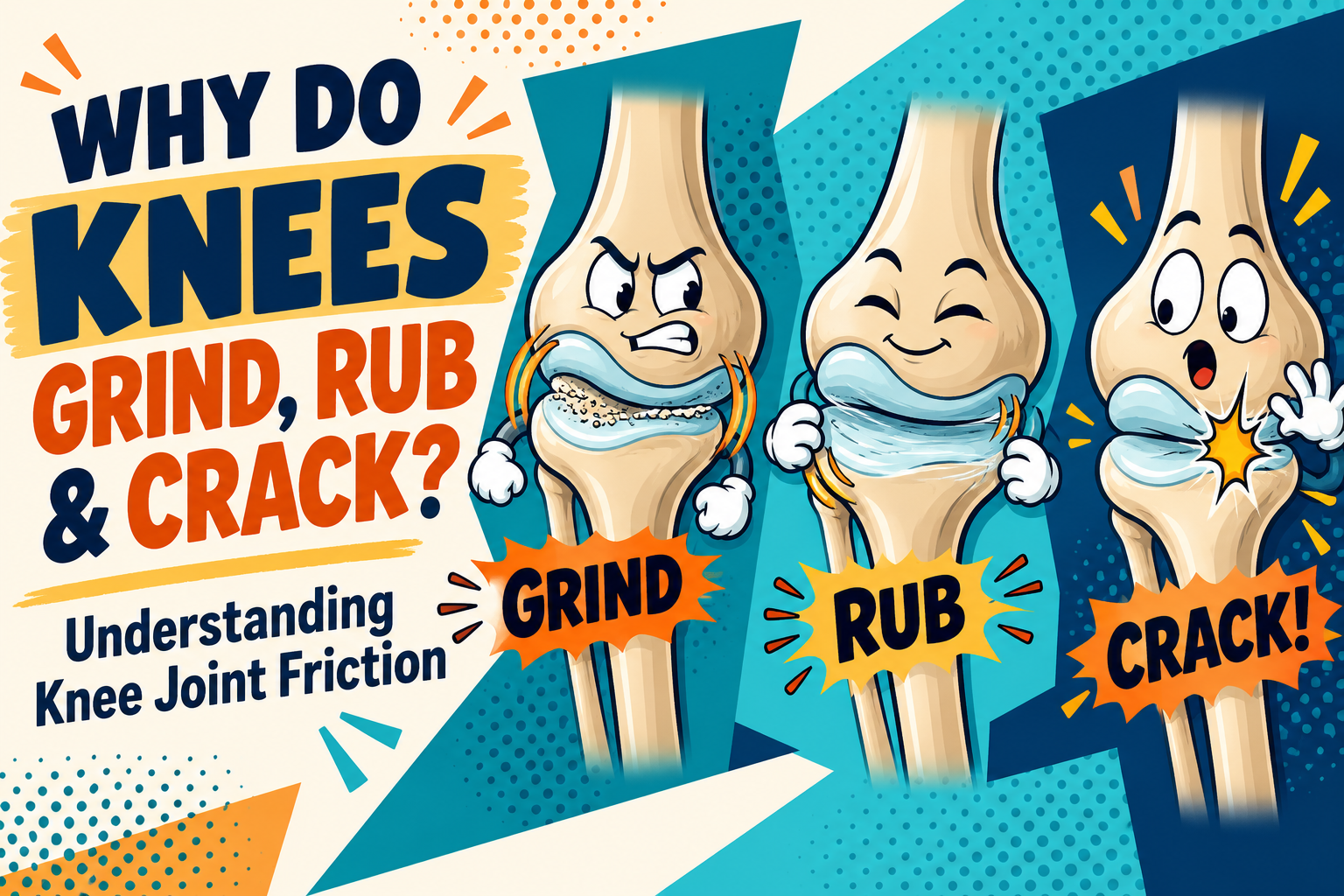
You bend down, stand back up, and hear a rough grinding noise from your knee. It may feel as though two dry surfaces are rubbing together. That sensation naturally raises a worrying question: Are the bones grinding against each other?
The causes of knee joint friction are more complicated than a knee simply becoming “dry.” Cartilage damage can increase surface roughness, but grinding sensations may also involve the kneecap, synovial membrane, meniscus, tendons, muscle weakness, swelling, or harmless pressure changes inside the joint.
Noise alone does not prove that serious damage is occurring. A quiet knee can be painful, and a noisy knee can function perfectly well. The details that matter most are whether the sensation is accompanied by pain, swelling, locking, instability, or a change in function.
Start Here: Which Type of Knee Friction Are You Feeling?
People use the word “friction” to describe several different experiences. Identifying the closest match provides a better starting point than assuming every noise is arthritis.
| What You Notice | Possible Explanation | What Makes It More Concerning |
|---|---|---|
| Fine crackling during bending | Crepitus, cartilage surface changes, or soft-tissue movement | Pain, swelling, or worsening function |
| Grinding behind the kneecap | Patellofemoral irritation, tracking changes, or cartilage wear | Pain on stairs, squats, or after sitting |
| One occasional pop | Pressure change, tendon movement, or normal joint mechanics | A traumatic pop followed by swelling or instability |
| Catching inside the knee | Meniscus injury, loose tissue, cartilage flap, or joint irregularity | True locking or inability to straighten the knee |
| Painful rubbing with swelling | Inflammation, osteoarthritis, injury, or synovitis | Warmth, redness, fever, or rapid swelling |
| Snapping over the outside or front | Tendon or other soft tissue moving across a bony structure | Repeated pain, tenderness, or loss of motion |
What Does “Knee Joint Friction” Actually Mean?
In a healthy knee, articular cartilage covers the ends of the femur and tibia and the back of the patella. This cartilage provides an exceptionally smooth, low-friction surface.
A thin layer of synovial fluid spreads across the cartilage. Hyaluronan and lubricin within that fluid contribute to lubrication. The menisci distribute load, while muscles guide the knee through controlled movement.
These systems normally allow the joint to move with very little resistance. Knee friction can increase—or simply feel as though it has increased—when one or more parts of this system change.
The sensation can come from three broad areas:
- Inside the joint: Cartilage, meniscus, bone, synovial membrane, or loose fragments.
- Around the joint: Tendons, muscles, ligaments, bursae, or the kneecap’s supporting tissues.
- Movement control: Strength, coordination, alignment, training load, or altered movement after pain.
The Knee Friction Map: Which Structure Can Cause What?
| Knee Structure | Normal Job | How It Can Contribute to Friction or Grinding |
|---|---|---|
| Articular cartilage | Creates a smooth gliding surface | Softening, thinning, or surface irregularities can increase roughness |
| Synovial fluid | Lubricates and nourishes joint surfaces | Changes in composition may reduce normal lubrication |
| Patella | Improves the quadriceps’ leverage | Irritation or altered tracking can produce grinding behind the kneecap |
| Menisci | Distribute force between the femur and tibia | Tears or displaced tissue may cause catching, clicking, or locking |
| Synovial membrane | Regulates the internal joint environment | Inflammation can cause swelling, stiffness, and altered movement |
| Tendons | Transfer muscle force to bone | A tendon can snap or rub across nearby structures |
| Quadriceps and hip muscles | Control force and knee position | Weakness may alter loading and reduce movement control |
| Bone | Provides the joint’s structural framework | Osteophytes, shape changes, or exposed surfaces may contribute to rough movement |
Cause 1: Articular Cartilage Changes
Cartilage does not contain pain-sensing nerves in the same way as skin or the joint capsule. Nevertheless, cartilage damage can change how forces pass through the knee and affect pain-sensitive structures nearby.
Articular cartilage may become softer, thinner, cracked, or irregular because of:
- Osteoarthritis
- A previous knee injury
- Repetitive high joint loading
- Abnormal joint structure
- An osteochondral injury
- Inflammatory joint disease
- Natural variation in cartilage development
As the surface becomes less uniform, movement may produce crepitus—a grinding, crackling, or crunching sensation.
This does not always mean the knee is literally “bone on bone.” Substantial cartilage can remain even when a person hears noise. Imaging and a clinical examination are needed to estimate the extent and location of structural changes.
Cause 2: Patellofemoral Friction Behind the Kneecap
The patella, or kneecap, glides through a groove at the lower end of the femur. This relationship is called the patellofemoral joint.
Pressure between the patella and femur increases during activities such as:
- Squatting
- Descending stairs
- Running downhill
- Kneeling
- Rising from a low chair
- Sitting with the knees bent for a long time
Grinding behind the kneecap may be associated with patellofemoral pain, cartilage softening, osteoarthritis, or changes in how the patella moves through its groove.
Possible contributing factors include:
- A sudden increase in running or lower-body exercise
- Reduced quadriceps capacity
- Hip muscle weakness
- Limited ankle mobility
- Joint swelling
- A previous patellar injury or dislocation
- Anatomical differences in the femoral groove or patella
The term “poor tracking” can be misleading if it suggests there is one perfect path for every kneecap. Anatomy naturally varies. The more useful question is whether load, strength, movement, and tissue capacity match the activities being performed.
Cause 3: Osteoarthritis Changes the Entire Joint
Osteoarthritis is often described as cartilage wear, but it is a disease of the whole joint. It may affect cartilage, bone, ligaments, menisci, synovium, and surrounding muscles.
As osteoarthritis progresses, the knee may develop:
- Rougher or thinner cartilage
- Bone spurs called osteophytes
- Changes in joint shape
- Synovial inflammation
- Meniscus degeneration
- Muscle weakness
- Stiffness and reduced range of motion
- Loose cartilage or bone fragments
These changes can produce grinding, scraping, or crunching sensations. Yet symptom severity does not always match the appearance of an X-ray. Some people have substantial imaging changes with little pain, while others have significant symptoms with less obvious structural damage.
Pain is influenced by inflammation, bone changes, muscle capacity, sleep, stress, previous experiences, and the sensitivity of the nervous system—not cartilage appearance alone.
Cause 4: Changes in Synovial Fluid
Synovial fluid creates a thin lubricating layer across cartilage surfaces. Hyaluronan contributes to the fluid’s viscosity and shock-absorbing qualities.
Injury, inflammation, and osteoarthritis can alter the composition of this fluid. Hyaluronan may become less concentrated or break into smaller molecules, reducing some of the fluid’s normal viscoelastic properties.
This is not the same as the knee simply running out of oil. An inflamed knee may actually produce excess joint fluid and become visibly swollen. The joint can therefore contain more fluid while experiencing poorer lubrication and movement.
Our articles on how synovial fluid lubricates the knee and whether hyaluronan may help knee pain explain this process in greater depth.
Cause 5: Meniscus Damage or Degeneration
The medial and lateral menisci are crescent-shaped fibrocartilage structures between the femur and tibia. They distribute load, contribute to stability, and help the joint surfaces fit together.
A meniscus can tear during a forceful twisting injury. It can also develop degenerative changes over time without one dramatic event.
Meniscus-related symptoms may include:
- Joint-line pain
- Swelling
- Clicking or catching
- Pain during twisting
- Difficulty fully bending or straightening the knee
- A sensation that something is moving inside the joint
Not every meniscus tear causes symptoms, and not every tear requires surgery. The location, type of tear, age of the tissue, activity demands, and presence of osteoarthritis all influence treatment.
A knee that becomes physically locked and cannot fully straighten warrants timely medical evaluation.
Cause 6: Synovitis and Joint Swelling
Synovitis is inflammation of the synovial membrane. The irritated membrane may thicken and produce excess fluid.
Swelling can change joint pressure and interfere with normal muscle activation. Even a relatively small effusion may inhibit the quadriceps, making the leg feel weak or poorly controlled.
Potential causes of synovitis include:
- Osteoarthritis
- Rheumatoid arthritis
- Gout or pseudogout
- Meniscus or ligament injuries
- Repetitive joint irritation
- Joint infection
When swelling limits normal movement, the body may adopt a stiff-legged walking pattern. This compensation can create additional rubbing or snapping sensations around the knee.
Cause 7: Muscle Weakness and Reduced Knee Control
Weak muscles do not directly scrape cartilage away. They can, however, reduce the body’s ability to control load and movement.
The quadriceps are especially important because they help control knee extension and the movement of the patella. The gluteal muscles influence the position of the pelvis and thigh, while the calf and hamstrings contribute to stability and force absorption.
Weakness can develop because of:
- Extended inactivity
- Pain-related movement avoidance
- Joint swelling
- Previous surgery or injury
- Neurological problems
- Rapidly increasing activity without preparation
A cycle can then develop:
- The knee becomes painful or swollen.
- The person moves less or changes how they walk.
- The quadriceps and supporting muscles lose capacity.
- Everyday activities represent a larger percentage of available strength.
- The knee becomes easier to irritate.
- Movement feels rougher, weaker, or less stable.
Appropriate strengthening can interrupt this cycle even when some structural changes remain present.
Cause 8: Tendons and Soft Tissues Snapping Over Bone
Not every friction sensation comes from inside the joint. Tendons and bands of connective tissue may shift across nearby bony structures during movement.
Examples can include:
- The iliotibial band near the outside of the knee
- Hamstring tendons near the inner or outer knee
- The quadriceps tendon above the patella
- The patellar tendon below the patella
- Scar tissue following surgery or injury
A painless, occasional snap may be harmless. Repeated snapping accompanied by pain, swelling, weakness, or loss of motion deserves evaluation.
Cause 9: Loose Bodies Inside the Joint
Small fragments of cartilage or bone can sometimes become loose inside the knee. These fragments may result from osteoarthritis, an osteochondral injury, or a less common condition such as synovial chondromatosis.
A loose body may move within the joint and intermittently cause:
- Catching
- Sharp pain
- Clicking
- Sudden loss of motion
- Locking
- Swelling
Because the fragment can change position, symptoms may appear and disappear. Repeated locking should not be dismissed as normal crepitus.
Cause 10: Changes After an Injury or Surgery
A previous ACL injury, meniscus tear, fracture, patellar dislocation, or operation can alter joint mechanics. Scar tissue, muscle loss, swelling, cartilage injury, and changes in confidence may all contribute to a sensation of friction.
Grinding after an injury does not automatically mean the repair has failed. The importance depends on:
- When the symptom began
- Whether pain and swelling are increasing
- Whether the knee remains stable
- Whether range of motion is improving
- Whether the sound occurs during a particular rehabilitation exercise
People recovering from surgery should follow the progression provided by their surgeon or physical therapist rather than using a general online routine.
Is Knee Crepitus Harmful?
Crepitus is the medical term commonly used for crackling, grinding, or grating sensations in or around a joint.
Crepitus can occur without pain and may not require treatment. Possible harmless sources include pressure changes in the joint, soft tissues shifting during movement, or minor surface irregularities that do not limit function.
Crepitus becomes more relevant when it appears with:
- Pain
- Swelling
- Warmth
- Stiffness
- Reduced range of motion
- Weakness or buckling
- Catching or locking
- A recent injury
The goal is not necessarily to make every knee completely silent. A better outcome is comfortable, confident movement with adequate strength and function.
Use This Three-Step Decision Sequence
Step 1: Is There Noise Without Pain?
If the knee makes noise but remains comfortable, stable, and fully functional, monitor it rather than assuming damage. Continue appropriate activity and pay attention to meaningful changes.
Step 2: Is There Pain but No Major Warning Sign?
Reduce the activity that clearly aggravates the knee, but avoid unnecessary total rest. Consider an evaluation if symptoms persist. Gradual strength and mobility work may be appropriate once the likely cause is understood.
Step 3: Is There Swelling, Locking, Instability, or Trauma?
Seek professional evaluation. These features provide more clinically useful information than the sound alone and may suggest an injury or inflammatory condition.
What Can Reduce the Feeling of Knee Friction?
The correct strategy depends on the cause. There is no single method that lubricates or realigns every painful knee.
Adjust the Irritating Activity
Temporarily change the depth, resistance, duration, speed, or frequency of an aggravating movement. The goal is to reduce excessive irritation while preserving as much comfortable activity as possible.
Build Quadriceps and Hip Strength
Progressive strengthening can improve load tolerance and movement control. Appropriate exercises may include modified sit-to-stands, step-ups, leg raises, bridges, and resistance-band movements.
The correct starting point should match current ability. Our comparison of the best at-home knee exercise programs can help readers evaluate structured options.
Improve Mobility Where It Is Actually Limited
Limited ankle or hip mobility may change how the knee moves during walking, squatting, or stairs. Stretching every structure indiscriminately is less useful than identifying the movement restriction that affects the task.
Address Swelling
Persistent effusion can restrict motion and inhibit the quadriceps. Treatment depends on whether the swelling comes from osteoarthritis, injury, gout, infection, or another condition.
Progress Exercise Gradually
Tendons, muscles, bones, and joints need time to adapt. A sudden jump in running distance, squat volume, hill walking, or recreational sports can exceed current capacity even when the activity is generally healthy.
Consider Weight Management When Appropriate
For people carrying excess body weight, gradual weight reduction may decrease the load passing through the knees. Weight is only one factor, and knee symptoms should not automatically be blamed on body size.
Can Joint Supplements Reduce Knee Friction?
Supplements cannot mechanically resurface cartilage or correct an unstable meniscus. Certain ingredients may support joint comfort or the biological environment surrounding the joint.
Oral hyaluronic acid is relevant because hyaluronan contributes to the properties of synovial fluid. Boswellia and ginger are commonly used to support a healthy inflammatory response, while collagen and glucosamine are promoted for cartilage-related support.
Evidence varies by ingredient, dosage, formulation, and individual. None should be presented as a guaranteed treatment for bone-on-bone arthritis.
Joint Genesis combines a Mobilee® hyaluronic acid matrix with Boswellia, ginger, French maritime pine bark, and BioPerine®. Readers interested in the formula can review our analysis of Joint Genesis ingredients, side effects, and expected results before considering the current offer through the Joint Genesis affiliate page.
Common Knee-Friction Myths
“Grinding Means My Knee Is Bone on Bone”
Not necessarily. Grinding can occur with patellofemoral irritation, cartilage surface changes, soft-tissue movement, or crepitus without advanced cartilage loss.
“If My Knee Cracks, Exercise Is Damaging It”
A painless noise does not automatically mean an exercise is harmful. Pain response, swelling, technique, stability, and next-day function provide more useful information.
“I Need to Rest Until Every Noise Disappears”
Total rest may reduce short-term irritation, but prolonged inactivity can worsen weakness and stiffness. Appropriate movement is often part of restoring function.
“Drinking More Water Will Refill a Dry Knee”
Normal hydration supports health, but water does not travel directly into the joint and eliminate friction. Synovial fluid is biologically regulated by the body.
“A Supplement Can Regrow All of My Cartilage”
No over-the-counter supplement has been conclusively shown to restore severely damaged knee cartilage. Nutritional support and cartilage regeneration are not the same claim.
When Knee Grinding Needs Prompt Medical Attention
Seek prompt medical care when grinding or friction occurs with:
- A hot, red, or rapidly swelling knee
- Fever or feeling seriously unwell
- Inability to bear weight
- A traumatic pop followed by swelling
- Visible deformity
- True locking of the joint
- Repeated buckling or instability
- Sudden calf pain or swelling
- Progressive numbness or weakness
- Severe pain following surgery or an injection
A hot, swollen joint with fever may indicate an infection. Septic arthritis can damage joint tissues quickly and requires urgent treatment.
Final Perspective: Treat the Cause, Not Just the Noise
The causes of knee joint friction range from harmless crepitus to cartilage damage, patellofemoral irritation, meniscus problems, synovitis, osteoarthritis, muscle weakness, and loose fragments inside the joint.
A grinding sound cannot reveal which one is responsible. The combination of pain location, swelling, injury history, movement limitations, locking, and instability is far more informative.
In our analysis, the most useful strategy is not to chase a perfectly silent knee. It is to identify the likely source, manage excessive irritation, rebuild appropriate strength, and watch for symptoms that require professional evaluation.
For a broader understanding of cartilage, joint lubrication, and knee mechanics, return to our complete guide to joint health.
Frequently Asked Questions About Knee Joint Friction
Why does my knee feel like it is rubbing?
A rubbing sensation may involve cartilage surface changes, the kneecap moving through its groove, swollen tissues, a meniscus problem, or tendons shifting over nearby structures. An examination may be needed when the sensation is painful or persistent.
What causes grinding under the kneecap?
Grinding under the kneecap is commonly associated with patellofemoral irritation, cartilage changes, osteoarthritis, joint swelling, or increased pressure during stairs, squats, and prolonged sitting.
Does knee grinding always mean arthritis?
No. Arthritis can cause crepitus, but painless knee noises also occur in people without significant symptoms. Pain, swelling, stiffness, and functional changes make the grinding more clinically important.
Can low synovial fluid cause knee friction?
Changes in synovial-fluid composition may affect lubrication. However, knees do not usually become painful because they simply run out of fluid. An inflamed knee can contain excess fluid with reduced lubricating quality.
Can knee cartilage grow back?
Articular cartilage has limited healing capacity. Small injuries may behave differently from widespread osteoarthritis, but no supplement or home remedy has been proven to regenerate all lost knee cartilage.
Why do my knees grind when climbing stairs?
Stairs increase pressure between the patella and femur. Grinding may become more noticeable when patellofemoral tissues are irritated, cartilage surfaces are irregular, or the quadriceps and hip muscles lack sufficient capacity.
Should I stop squatting if my knees crack?
Noise without pain does not automatically require stopping. If squatting causes sharp pain, swelling, instability, or worsening symptoms, reduce the load or range and obtain guidance before progressing.
Can strengthening reduce knee grinding?
Strengthening may improve movement control, load tolerance, and symptoms, but it may not eliminate every sound. Comfortable function is a more useful goal than complete silence.
What is the difference between knee friction and crepitus?
Knee friction describes the mechanical concept or sensation of surfaces resisting movement. Crepitus is the crackling, grinding, or grating sound or feeling experienced during joint motion.
When should I see a doctor about knee grinding?
Arrange an evaluation when grinding is painful, persistent, associated with swelling, or limits activity. Seek prompt care after a significant injury or when the knee is hot, red, locked, unstable, or unable to bear weight.
Medical References
- National Institute of Arthritis and Musculoskeletal and Skin Diseases: Osteoarthritis
- Cleveland Clinic: Knee Arthritis Symptoms and Causes
- Cleveland Clinic: Patellar Grinding and Patellofemoral Cartilage
- Arthritis Foundation: Osteoarthritis, Exercise, and Joint Function
- Cleveland Clinic: Loose Bodies and Synovial Chondromatosis
Affiliate disclosure: This article contains affiliate links. If you purchase through one of these links, Let’s Rebuild Your Knees may earn a commission at no additional cost to you. Affiliate compensation does not change our responsibility to discuss evidence, limitations, and safety concerns accurately.
Medical disclaimer: This article provides general educational information and is not a diagnosis or substitute for medical care. Knee grinding can have many causes. Consult a qualified healthcare professional for persistent pain, swelling, locking, instability, or reduced function. Seek urgent medical attention for a hot, red, rapidly swelling joint, fever, major trauma, or inability to bear weight.