Hyaluronan for Knee Pain: Does Hyaluronic Acid Really Help?
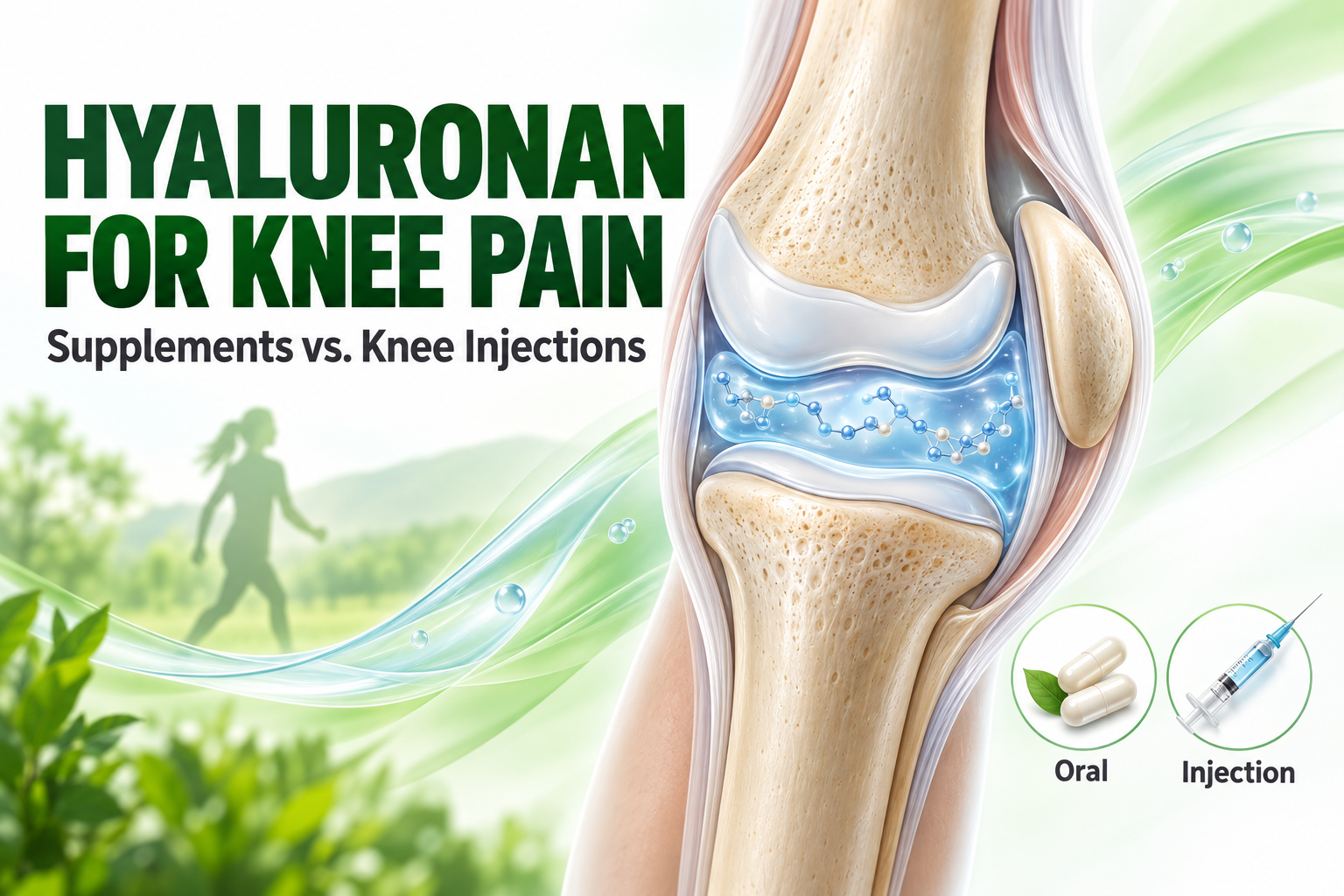
Interest in hyaluronan for knee pain has grown because this naturally occurring molecule helps give synovial fluid its slippery, shock-absorbing properties. Hyaluronan is available in oral joint supplements and as a gel-like injection administered directly into the knee, but these two approaches are not equivalent.
Research suggests that certain people may experience modest improvements in knee comfort or function. However, results vary, the evidence remains debated, and neither oral nor injected hyaluronan has been proven to rebuild severely damaged cartilage.
In our analysis, oral hyaluronan is the more accessible option for people interested in nutritional joint support, while injections require a medical procedure and should be considered through shared decision-making with a qualified clinician.
Key takeaway: Hyaluronan may support joint lubrication and help some people manage knee symptoms, but it is not a cure for osteoarthritis or a universal solution for every type of knee pain.
What Is Hyaluronan?
Hyaluronan is a large carbohydrate molecule naturally produced by the human body. It is also called hyaluronic acid or sodium hyaluronate, depending on its chemical form and how it is used in a product.
For most consumer discussions, the terms hyaluronan and hyaluronic acid refer to the same basic family of molecules. Hyaluronan is generally the preferred scientific term for the form present under normal physiological conditions.
Hyaluronan is found throughout the body, including the:
- Synovial fluid inside movable joints
- Articular cartilage covering the ends of bones
- Skin and connective tissue
- Eyes
- Umbilical cord
- Extracellular matrix surrounding cells
One of its most important characteristics is its ability to attract and retain water. In a joint, this contributes to lubrication, viscosity, load distribution, and tissue hydration.
How Does Hyaluronan Work in the Knee?
The knee is a synovial joint. Its moving surfaces are enclosed by a joint capsule lined with a synovial membrane. This membrane helps produce and regulate synovial fluid.
Hyaluronan gives healthy synovial fluid much of its thick, slippery consistency. It works with another molecule called lubricin and with the exceptionally smooth surface of articular cartilage.
Together, these structures help:
- Reduce friction between moving joint surfaces
- Distribute forces across the knee
- Support the viscoelastic qualities of synovial fluid
- Transport nutrients toward cartilage
- Carry metabolic waste products away
- Maintain hydration within joint tissues
Our guide explaining what synovial fluid is and how it protects the knee examines these functions in greater detail.
Why Is Hyaluronan Used for Knee Pain?
Osteoarthritis can affect the entire joint, including the cartilage, underlying bone, synovial membrane, ligaments, menisci, muscles, and synovial fluid. The concentration and molecular characteristics of hyaluronan may change as osteoarthritis progresses.
These changes can reduce the fluid’s viscoelastic performance. At the same time, inflammation may cause the synovial membrane to produce excess fluid, leading to swelling.
This creates an important distinction: an arthritic knee may contain too much fluid while still having lower-quality lubrication. More fluid does not automatically mean healthier fluid.
Hyaluronan products are intended to support this joint environment in one of two ways:
- Oral hyaluronan supplements are swallowed and processed through the digestive system.
- Intra-articular hyaluronan injections place a gel-like product directly inside the knee joint.
The two approaches have different evidence, costs, risks, and mechanisms.
Oral Hyaluronan for Knee Pain
Oral hyaluronan is sold as a capsule, tablet, powder, or liquid. Some products contain hyaluronic acid alone, while others combine it with collagen, Boswellia serrata, ginger, glucosamine, chondroitin, or other joint-support ingredients.
A common misconception is that swallowed hyaluronan passes through the digestive system intact and flows directly into the knee. Digestion and absorption are more complicated.
Large hyaluronan molecules can be broken into smaller fragments by digestion and intestinal microorganisms. Researchers have proposed that these fragments may be absorbed or may influence biological signaling that affects the body’s own production and regulation of hyaluronan.
The exact mechanism behind any joint benefit has not been fully established.
What Does the Research Show?
Human trials of oral hyaluronic acid have reported improvements in certain measures of knee discomfort, muscle strength, mobility, or physical function. A 2024 systematic review found that most included studies reported at least one favorable outcome.
The findings need to be interpreted cautiously for several reasons:
- Many studies included relatively small groups.
- Trials used different hyaluronan sources and molecular weights.
- Dosages and treatment durations varied.
- Several products combined hyaluronan with other ingredients.
- Some studies involved people with mild symptoms rather than severe osteoarthritis.
- Industry funding can introduce bias.
When a combination product produces a benefit, researchers cannot always determine how much of the result came from hyaluronan rather than the other ingredients.
The evidence is therefore promising enough to justify continued research, but not strong enough to guarantee meaningful relief for every user.
How Long Might Oral Hyaluronan Take to Work?
Oral hyaluronan is not a fast-acting pain medication. Studies commonly assess results over periods ranging from several weeks to three months or longer.
A practical evaluation may involve:
- Recording knee symptoms and function before starting
- Using the product consistently according to its label
- Monitoring side effects during the first two weeks
- Comparing repeatable activities after eight to twelve weeks
- Stopping if no meaningful improvement justifies the ongoing cost
Useful measures include morning stiffness, walking tolerance, stair comfort, chair-rise ability, and reliance on over-the-counter pain medication.
Possible Oral Hyaluronan Side Effects
Oral hyaluronan appears to be tolerated by many healthy adults, but possible side effects can include:
- Nausea
- Stomach discomfort
- Bloating
- Loose stools
- Headache
- Skin irritation
- Allergic reactions
The hyaluronan source matters. Some ingredients are produced through microbial fermentation, while others are derived from poultry tissues such as chicken comb. People with poultry or egg-related allergies should examine the label carefully.
Combination products create additional safety considerations. Ginger, Boswellia, turmeric, and black pepper extract may interact with prescription medications even if hyaluronan itself does not.
Joint Genesis as an Oral Hyaluronan Option
BioDynamix Joint Genesis is a dietary supplement built around an 80 mg Mobilee® hyaluronic acid matrix. The formula also includes ginger root, French maritime pine bark extract, Boswellia serrata, and BioPerine® black pepper extract.
| Joint Genesis Ingredient | Listed Amount | Proposed Purpose |
|---|---|---|
| Ginger root powder | 200 mg | Supports a healthy inflammatory response |
| French maritime pine bark extract | 150 mg | Provides antioxidant and circulation support |
| Boswellia serrata extract | 100 mg | May support joint comfort and flexibility |
| Mobilee® hyaluronic acid matrix | 80 mg | Supports hyaluronan and the joint-lubrication environment |
| BioPerine® black pepper extract | 5 mg | Included to influence ingredient bioavailability |
We consider Joint Genesis a noteworthy oral hyaluronan option because it discloses each active ingredient amount and combines lubrication-focused support with botanical ingredients. That does not prove that the finished formula will work for everyone.
Readers interested in trying an oral formula can first read our balanced Biodynamix Joint Genesis review, which covers its complete ingredient list, possible side effects, realistic results, and purchasing considerations. The latest offer can then be reviewed through the official Joint Genesis promotion.
Hyaluronan Knee Injections
Hyaluronan knee injections are also known as hyaluronic acid injections or viscosupplementation. A healthcare professional places a gel-like hyaluronan product directly into the knee joint.
Depending on the specific product, treatment may involve one injection or a series of injections given over several weeks. The molecular weight, concentration, source, cross-linking, and volume vary among products.
Injections are generally considered for knee osteoarthritis rather than undiagnosed knee pain. A clinician may discuss them when exercise, activity modification, medication, or other conservative approaches have not produced adequate relief.
What Happens During the Procedure?
The skin around the knee is cleaned, and a needle is guided into the joint space. If the knee has a significant effusion, the clinician may remove excess fluid before injecting the hyaluronan product.
Some clinicians use anatomical landmarks, while others use ultrasound guidance. The entire procedure is usually completed during an office visit.
Patients may be advised to avoid strenuous weight-bearing activity for a short period afterward. Instructions vary, so the treating clinician’s guidance should take priority.
Do Hyaluronan Knee Injections Work?
The evidence is controversial. Some randomized trials and meta-analyses report reductions in pain and improvements in function, particularly several weeks or months after treatment. Other analyses find that the average benefit over placebo is too small or inconsistent to justify routine use.
Professional guidelines also differ:
- The American Academy of Orthopaedic Surgeons states that hyaluronic acid injections are not recommended for routine use in symptomatic knee osteoarthritis.
- The American College of Rheumatology and Arthritis Foundation conditionally recommend against their use for knee osteoarthritis.
- Some international guidance allows consideration in selected patients, particularly when core treatments have not provided adequate relief or other medications are unsuitable.
A recommendation against routine use does not mean that no individual ever benefits. It means the average evidence is not strong or consistent enough to recommend the treatment broadly.
Who May Be More Likely to Consider an Injection?
A clinician may be more willing to discuss viscosupplementation when a patient:
- Has confirmed knee osteoarthritis
- Has mild to moderate rather than end-stage disease
- Has not improved sufficiently with exercise and activity modification
- Cannot safely use certain oral pain medications
- Understands that the benefit may be modest or absent
- Wants to postpone more invasive treatment
- Has reviewed cost and insurance coverage
These are discussion points rather than guarantees that an injection is appropriate.
Possible Injection Side Effects
Potential adverse effects include:
- Temporary pain at the injection site
- Swelling or warmth around the knee
- Joint stiffness
- Bruising or bleeding
- A temporary inflammatory flare
- Allergic reaction
- Joint infection
Infection is uncommon but potentially serious. Increasing pain, redness, warmth, swelling, fever, or difficulty bearing weight after an injection requires prompt medical attention.
People taking anticoagulants or antiplatelet medication should tell the clinician before the procedure. Anyone with an infection in or around the knee generally should not receive an injection until appropriately evaluated.
Oral Hyaluronan vs. Knee Injections
| Feature | Oral Hyaluronan | Hyaluronan Injection |
|---|---|---|
| How it is used | Swallowed as a capsule, tablet, powder, or liquid | Injected directly into the knee joint |
| Access | Available without a prescription as a dietary supplement | Requires a qualified healthcare professional |
| Typical purpose | General joint comfort, mobility, and nutritional support | Management of diagnosed knee osteoarthritis symptoms |
| Evidence | Promising but limited and product-dependent | Extensively studied but conflicting |
| Main risks | Digestive symptoms, allergy, and combination-ingredient interactions | Post-injection flare, bleeding, allergic reaction, and infection |
| Cost | Ongoing supplement expense | Higher procedure cost with variable insurance coverage |
| Expected result | Potential gradual, modest support | Potential temporary symptom improvement |
| Cartilage regrowth | Not proven | Not proven |
Can Hyaluronan Rebuild Knee Cartilage?
There is not sufficient clinical evidence to claim that either oral or injected hyaluronan regrows severely damaged human knee cartilage.
Hyaluronan participates in normal cartilage and synovial-fluid biology. Laboratory research suggests it may influence inflammation, cartilage-cell behavior, and the extracellular matrix. Those biological effects do not establish that it can restore an arthritic joint to its original structure.
Articular cartilage has limited healing capacity because it lacks a direct blood supply. Osteoarthritis also affects far more than cartilage. It can involve:
- The bone beneath the cartilage
- The synovial membrane
- Menisci
- Ligaments
- Joint capsule
- Fat pad
- Surrounding muscles
- Pain-processing pathways
A treatment may improve comfort without producing visible cartilage growth. Conversely, imaging changes do not always correspond directly with the amount of pain a person experiences.
What Types of Knee Pain Are Unlikely to Respond?
Hyaluronan is unlikely to correct knee pain caused primarily by:
- An acute ligament tear
- A displaced meniscus tear
- A fracture
- Patellar instability
- A tendon rupture
- Septic arthritis
- Gout requiring medical treatment
- Nerve compression
- Pain referred from the hip or spine
- Severe mechanical instability
This is why identifying the likely cause matters before investing in a supplement or injection.
Hyaluronan Compared With Other Knee-Pain Approaches
| Approach | Main Role | Important Limitation |
|---|---|---|
| Oral hyaluronan | Nutritional support for joint comfort and mobility | Evidence is limited and benefits may be modest |
| Hyaluronan injection | Possible temporary relief for selected people with knee osteoarthritis | Conflicting guidelines and procedure-related risks |
| Strength and mobility exercise | Improves muscle capacity, movement control, and function | Requires consistency and appropriate progression |
| Weight management | May reduce load on weight-bearing joints when appropriate | Not every person with knee pain needs weight loss |
| Topical or oral medication | May reduce pain and inflammation | Side effects and contraindications vary |
| Physical therapy | Provides individualized assessment and exercise progression | Requires access, appointments, and possible out-of-pocket cost |
Why Exercise Still Matters
Hyaluronan focuses on the biological and lubricating environment of the joint. It does not restore quadriceps strength, improve balance, or teach the body to manage force more effectively.
The quadriceps help control knee extension and absorb load during walking, stair climbing, and rising from a chair. The hip muscles influence the position of the thigh, while calf strength and ankle mobility affect how the leg moves over the foot.
Exercise may improve function even when osteoarthritis remains visible on an X-ray. A suitable program can address:
- Quadriceps activation
- Hip and hamstring strength
- Balance and coordination
- Comfortable range of motion
- Walking tolerance
- Confidence in movement
Readers who prefer a movement-centered option can compare our best at-home knee pain exercise programs.
How to Evaluate an Oral Hyaluronan Product
Look for a Disclosed Dosage
The label should identify how much hyaluronan or hyaluronic acid is present per complete daily serving. Avoid assuming that an ingredient is meaningfully dosed merely because its name appears on the bottle.
Identify the Source
Check whether the ingredient is produced by microbial fermentation or derived from poultry tissue. This matters for allergies and dietary preferences.
Review Every Added Ingredient
A hyaluronan supplement may also contain herbs, minerals, collagen, shellfish-derived glucosamine, or absorption enhancers. Evaluate the entire formula rather than focusing only on its headline ingredient.
Check for Independent Testing
Certification or testing from an independent organization may provide additional reassurance about ingredient identity and contamination. Quality testing does not prove effectiveness.
Compare the Cost Per Daily Serving
Use the full label dosage when calculating monthly cost. A low bottle price can be misleading if the recommended serving requires several capsules.
Reject Guaranteed Cure Claims
A responsible product should not claim to cure arthritis, restore every damaged joint, or eliminate the need for professional care.
Who Should Ask a Healthcare Professional Before Using Hyaluronan?
Obtain medical guidance before using an oral or injected hyaluronan product if you:
- Are pregnant or breastfeeding
- Have a poultry or egg-related allergy
- Take anticoagulant or antiplatelet medication
- Use several prescription medications
- Have a history of severe allergic reactions
- Have an autoimmune or inflammatory joint disease
- Have liver, kidney, or bleeding problems
- Are preparing for surgery
- Have an infection or damaged skin near the knee
- Recently received another knee injection
A pharmacist can be especially helpful when evaluating a multi-ingredient oral product for medication interactions.
When Knee Pain Needs Prompt Evaluation
Do not rely on a hyaluronan supplement when symptoms include:
- A hot, red, or rapidly swelling knee
- Knee pain accompanied by fever
- Inability to bear weight
- A major twisting injury, fall, or collision
- Visible deformity
- A knee that locks or repeatedly gives way
- Sudden calf pain or swelling
- Progressive numbness or weakness
- Severe pain following an injection
A hot, swollen joint with fever can indicate septic arthritis. This requires urgent medical evaluation because infection can damage joint tissues quickly.
Our Verdict on Hyaluronan for Knee Pain
Hyaluronan for knee pain is biologically plausible and supported by some encouraging research, but expectations should remain measured.
Oral hyaluronan offers a convenient, noninvasive approach. Early studies suggest it may support comfort or function for certain users, although research varies in quality and often involves combination products.
Hyaluronan injections have been studied more extensively, but results and clinical recommendations remain inconsistent. Some patients report temporary relief, while major U.S. guidelines do not recommend injections for routine knee-osteoarthritis use.
Neither option has been proven to regenerate advanced cartilage damage. Hyaluronan is best considered as one possible component of a broader knee-management strategy that may include exercise, activity modification, weight management when appropriate, medication, and professional rehabilitation.
For readers who prefer an oral supplement, Joint Genesis stands out because its label combines Mobilee® hyaluronic acid matrix with several complementary botanical ingredients. Review the evidence and precautions in our complete Joint Genesis analysis before deciding whether it fits your needs.
Frequently Asked Questions
Are hyaluronan and hyaluronic acid the same thing?
They refer to the same basic family of molecules. Hyaluronan is the form generally present at physiological pH, while hyaluronic acid and sodium hyaluronate are common terms used in consumer products and medical treatments.
Does hyaluronan help knee pain?
Some studies report improvements in knee comfort and function from oral or injected hyaluronan. Other research finds limited or inconsistent benefit. Results depend on the formulation, treatment method, condition severity, and individual response.
Can oral hyaluronic acid reach the knee?
Oral hyaluronic acid is processed by digestion and does not simply travel intact into the knee. Researchers propose that absorbed fragments and biological signaling may influence the body’s joint tissues, but the exact mechanism is still being investigated.
How long does oral hyaluronan take to work?
If benefits occur, they may require several weeks or months. An eight- to twelve-week monitored trial is more reasonable than expecting immediate relief.
How long do hyaluronic acid knee injections last?
Some patients report improvement lasting several months, while others experience little or no benefit. The response varies by product, arthritis severity, and individual factors.
Are hyaluronic acid injections painful?
The injection can cause temporary discomfort, pressure, or soreness. Some patients develop short-term swelling or an inflammatory flare afterward.
Are hyaluronan knee injections FDA approved?
Specific viscosupplementation products are cleared or approved for particular uses involving knee osteoarthritis. This does not mean professional organizations universally recommend them or that every patient will benefit.
Does hyaluronan regrow cartilage?
There is insufficient clinical evidence that oral supplements or knee injections regenerate severely damaged cartilage. They may influence symptoms or joint biology without rebuilding the joint’s original structure.
Is hyaluronan better than glucosamine?
The ingredients have different proposed mechanisms, and evidence for both is mixed. Hyaluronan focuses more directly on the synovial-fluid environment, while glucosamine is marketed as a cartilage-related building block.
Can I combine hyaluronan with knee exercises?
Many people use nutritional joint support alongside exercise. Exercise addresses strength and movement capacity, while hyaluronan targets a different aspect of joint health. Obtain professional guidance when symptoms or medical conditions make exercise safety uncertain.
Medical References
- American Academy of Orthopaedic Surgeons: Viscosupplementation for Knee Arthritis
- American Academy of Orthopaedic Surgeons: Knee Osteoarthritis Clinical Practice Guideline
- American College of Rheumatology: Osteoarthritis Treatment Guideline
- National Library of Medicine: Oral Hyaluronic Acid in Osteoarthritis
- National Institute of Arthritis and Musculoskeletal and Skin Diseases: Osteoarthritis
- Cleveland Clinic: Hyaluronic Acid Uses and Safety
Affiliate disclosure: This article contains affiliate links. If you purchase through one of these links, Let’s Rebuild Your Knees may earn a commission at no additional cost to you. Compensation does not change our responsibility to discuss the evidence, limitations, and potential risks accurately.
Medical disclaimer: This content is for general educational purposes and is not medical advice. Hyaluronan supplements are not intended to diagnose, treat, cure, or prevent disease. Knee injections must be evaluated and administered by a qualified healthcare professional. Seek prompt medical care for a hot, red, rapidly swelling joint, fever, inability to bear weight, or severe symptoms following an injection.