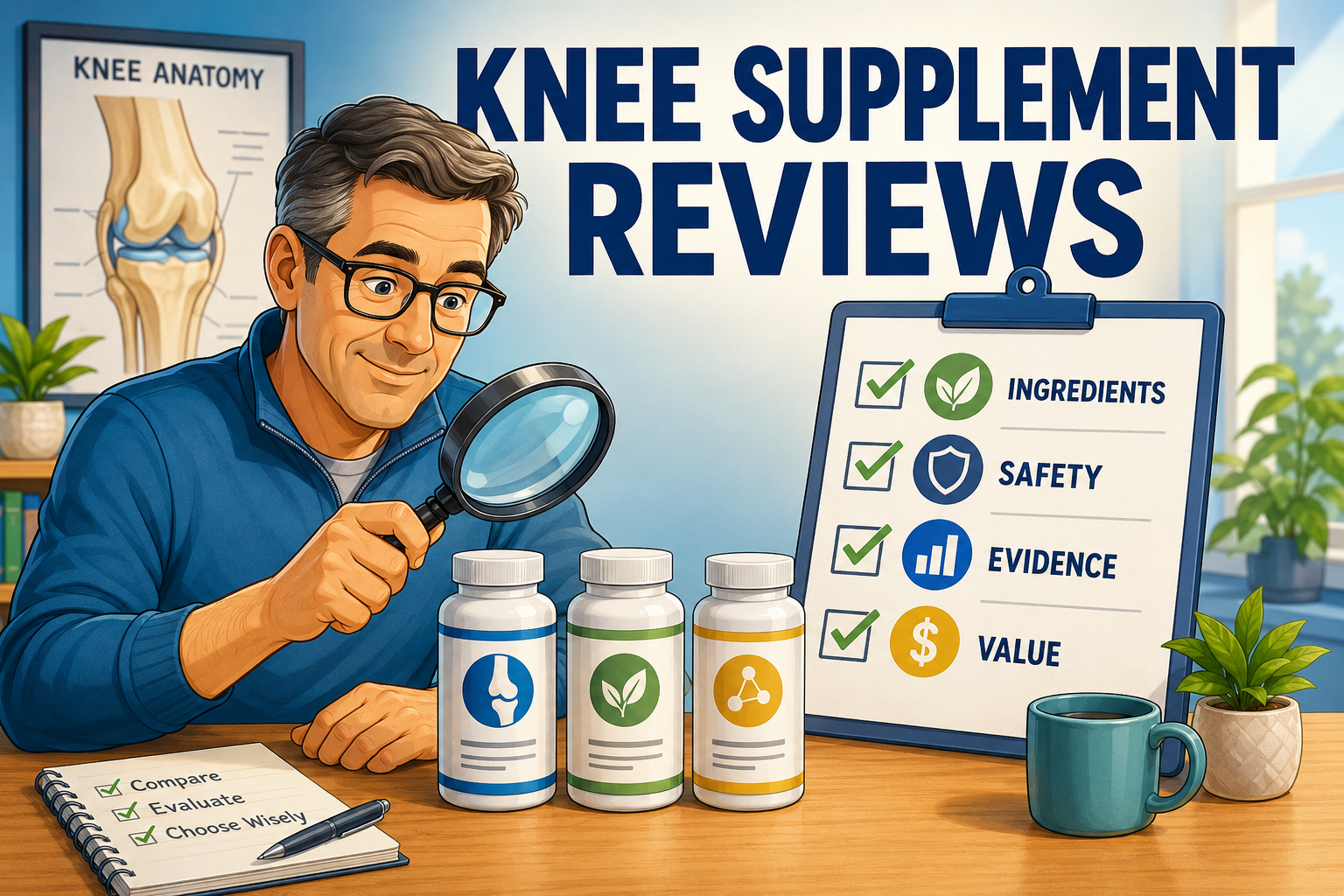
Knee Supplement Reviews, Ingredient Analysis and Product Comparisons
Our knee supplement reviews help readers look beyond marketing promises and examine what a joint product actually contains, what its ingredients may reasonably do, and where its limitations begin. We evaluate product formulas, safety considerations, side effects, pricing, refund policies, customer feedback, and the quality of available evidence.
Choosing a knee supplement can be confusing. Similar products may use completely different ingredients, while competing companies frequently make overlapping claims about cartilage, synovial fluid, flexibility, inflammation, and joint comfort. A polished label does not establish that a product will work, and a long ingredient list does not automatically make one formula better than another.
This review center is designed to help you compare products more carefully without assuming that any supplement can cure arthritis, regrow missing cartilage, repair an injury, or replace appropriate medical treatment.
Important: Dietary supplements are not substitutes for medical diagnosis, prescribed treatment, or individualized rehabilitation. Speak with a physician or pharmacist before using a new supplement if you take medication, have a chronic medical condition, are pregnant or nursing, or are preparing for surgery.
How Our Knee Supplement Reviews Help You
Most people do not need another list of products accompanied by vague statements such as “supports healthy joints.” They need enough information to decide whether a formula makes sense for their goals, health history, and budget.
Our reviews are organized around practical questions:
- What ingredients are included?
- Are the ingredient amounts clearly disclosed?
- What does the research say about those ingredients?
- Does the product make realistic claims?
- What side effects or interactions should be considered?
- How long might someone reasonably evaluate it?
- Are subscriptions or recurring charges involved?
- What does the refund policy actually require?
- Are customer complaints concentrated around a recurring issue?
- How does the product compare with exercise, physical therapy, and other options?
These questions allow us to examine each product according to its intended purpose rather than ranking it solely by popularity, commission, or promotional language.
Start With Our Featured Knee Supplement Reviews
Biodynamix Joint Genesis Review
Joint Genesis is a dietary supplement marketed for aging joints and reduced mobility. Its advertising places particular emphasis on synovial fluid and hyaluronan, but those ideas must be separated from the evidence supporting each ingredient and from the results an individual user might experience.
Our complete review examines:
- The Joint Genesis ingredient formula
- The proposed purpose of its primary ingredients
- Whether the ingredient amounts are disclosed
- Potential side effects and medication interactions
- The difference between joint support and cartilage regeneration
- Expected versus guaranteed results
- Customer feedback and common complaints
- Pricing, ordering options, and refund considerations
- Who may or may not be a suitable user
Read the complete Biodynamix Joint Genesis review covering ingredients, side effects and results.
Best Knee Supplements Analyzed
The phrase “best knee supplement” can be misleading because no formula is universally best. A product that suits one person may be inappropriate for another due to allergies, medication interactions, dietary restrictions, health conditions, ingredient preferences, or cost.
Our comparison guide evaluates popular categories of knee supplements using consistent criteria. Instead of ranking products according to advertising strength, we look at formula transparency, ingredient relevance, safety, value, and the realism of the manufacturer’s claims.
The guide also explains the differences among ingredients commonly found in joint products, including:
- Glucosamine and chondroitin
- Hyaluronic acid
- Undenatured type II collagen
- Curcumin and turmeric extracts
- Boswellia serrata
- Omega-3 fatty acids
- MSM
- Ginger and other botanical extracts
- Vitamins and minerals involved in normal tissue function
See our analysis of the top knee pain supplements and how their formulas compare.
How We Evaluate Joint Supplements
A useful review needs more than a summary of the sales page. We use several categories to assess the overall quality and practical value of a knee supplement.
| Review category | What we examine |
|---|---|
| Formula transparency | Whether ingredients and individual amounts are clearly disclosed |
| Ingredient evidence | Human research, study quality, dosage and relevance to the product’s claims |
| Safety | Side effects, allergens, contraindications and possible interactions |
| Claim quality | Whether promotional promises match what the evidence can support |
| Usability | Serving size, capsule count, frequency and practical daily use |
| Price and value | Cost per serving, multi-bottle offers and comparison with alternatives |
| Purchase terms | Subscriptions, shipping, returns and refund conditions |
| Customer feedback | Recurring positive experiences, complaints and service concerns |
Understanding Joint Supplement Ingredients
Ingredients should be evaluated individually before judging the formula as a whole. A substance may have a plausible biological role without producing a meaningful benefit when taken as a supplement. It is also important to distinguish laboratory research, animal studies, observational evidence, and controlled human trials.
Hyaluronic Acid
Hyaluronic acid, also called hyaluronan, is naturally present in synovial fluid and other tissues. Within a healthy joint, it contributes to lubrication and the physical properties of synovial fluid.
That does not mean every oral hyaluronic acid product will automatically restore the knee’s synovial fluid. The formulation, dose, absorption, study population, and measured outcome all matter.
For a broader explanation of joint lubrication, visit our guide to cartilage, hyaluronan and synovial fluid.
Glucosamine and Chondroitin
Glucosamine and chondroitin are among the most familiar joint-supplement ingredients. Research results have been mixed, and outcomes may depend on the form, dose, product quality, and population studied.
These ingredients can also create safety considerations. For example, people taking certain blood-thinning medications or those with relevant allergies should consult a qualified healthcare professional before use.
Collagen
Collagen products are marketed for joints, skin, tendons, and connective tissue. Different collagen types and processing methods should not be treated as interchangeable. Hydrolyzed collagen peptides and undenatured type II collagen are distinct ingredients with different proposed uses.
Turmeric and Curcumin
Curcumin is a group of compounds associated with turmeric. Supplement formulas may use extracts, absorption enhancers, or proprietary delivery systems because ordinary curcumin has limited bioavailability.
Curcumin products may cause digestive symptoms and may not be appropriate with certain medications or medical conditions. Higher absorption is not automatically better when it also increases the possibility of interactions.
Boswellia
Boswellia serrata extracts are frequently marketed for joint comfort. Product quality can vary based on extract standardization and the concentration of specific boswellic acids. The presence of Boswellia on a label does not reveal whether the formula resembles one used in clinical research.
What Knee Supplements Can and Cannot Do
Realistic expectations are essential when reading knee supplement reviews. Supplements may support general nutrition or help some users manage aspects of joint comfort, but their effects vary.
A knee supplement may potentially:
- Provide ingredients associated with normal joint or connective-tissue function
- Offer modest comfort support for some users
- Complement an appropriate exercise and recovery plan
- Provide a convenient way to consume selected nutrients
A supplement should not be expected to:
- Diagnose the cause of knee pain
- Rebuild lost muscle strength
- Correct poor balance or movement mechanics
- Repair a torn ligament or meniscus
- Reverse advanced osteoarthritis
- Regrow cartilage on demand
- Replace prescribed medication without medical supervision
- Guarantee that surgery will never be necessary
Key takeaway: A supplement may be one part of a broader knee-health strategy, but swallowing a capsule does not provide the mechanical benefits of strength training, mobility work, balance practice, or appropriate physical activity.
Supplements Versus Physical Rehabilitation
Supplements and knee rehabilitation address different needs. Nutritional products provide ingredients, while rehabilitation uses movement and progressive resistance to improve physical capacity.
Knee rehabilitation may help improve:
- Quadriceps and hip strength
- Joint range of motion
- Balance and coordination
- Walking and stair tolerance
- Confidence during daily movement
- The ability of surrounding muscles to manage force
A supplement cannot produce these adaptations without physical activity. Conversely, an exercise program does not correct every nutritional deficiency or provide the ingredients found in a supplement.
Learn more in our comprehensive guide to knee rehabilitation and strength training or explore our holistic knee recovery comparison center.
How to Read Customer Reviews Critically
Customer feedback can identify patterns that clinical research and product labels do not capture. Reviews may reveal problems involving shipping, automatic billing, capsule size, taste, customer service, or refund processing.
However, testimonials cannot establish that a supplement caused a medical improvement. Knee symptoms can fluctuate due to activity, rest, medication, expectations, natural recovery, and other simultaneous changes.
When assessing customer reviews, ask:
- Is the review tied to a verified purchase?
- Does it describe a specific experience or repeat promotional language?
- How long did the person use the product?
- Were other treatments or lifestyle changes used at the same time?
- Do similar positive or negative patterns appear across multiple sources?
- Is the website selling the product or receiving affiliate compensation?
Very positive testimonials and extremely negative complaints can both provide useful clues, but neither should be treated as controlled medical evidence.
Side Effects and Supplement Interactions
Dietary supplements can cause adverse effects even when their ingredients are described as natural. Potential reactions depend on the formula, dose, individual health history, and other substances being taken.
Possible concerns may include:
- Digestive discomfort, nausea or diarrhea
- Headaches or dizziness
- Allergic reactions
- Changes in bleeding risk
- Effects on blood sugar or blood pressure
- Interactions with prescription medication
- Problems related to excessive or overlapping nutrient intake
Combining multiple joint products may result in duplicated ingredients. Always compare the complete Supplement Facts labels rather than relying on the product names.
Stop using a supplement and seek appropriate medical help if you experience signs of a serious allergic reaction or another severe adverse effect.
Questions to Ask Before Buying a Knee Supplement
- What am I trying to improve? Be specific about whether your concern is stiffness, pain, mobility, weakness, or general nutritional support.
- Do I know why my knee hurts? A supplement should not delay assessment of a significant injury or unexplained symptoms.
- Are all ingredient amounts disclosed? Proprietary blends can make meaningful dosage comparisons difficult.
- Does the research match this formula? Evidence for one ingredient or dose does not automatically validate every product containing it.
- Could it interact with my medication? Ask a physician or pharmacist when uncertain.
- Is there automatic billing? Read the order page before submitting payment.
- What does the refund policy require? Note deadlines, return-shipping requirements and whether opened containers qualify.
- Can I evaluate results objectively? Track the same activities and symptoms rather than relying solely on memory.
How Long Should You Evaluate a Joint Supplement?
There is no universal evaluation period. Some products are intended for daily use over several weeks, while others may be poorly tolerated after the first few servings.
Before beginning, record a small number of meaningful measurements. These might include morning stiffness duration, comfortable walking time, stair tolerance, or the ability to perform a daily activity.
Avoid starting several new supplements, exercises, or treatments simultaneously. If symptoms change, you may not know which intervention helped or caused a problem.
Stop and seek professional guidance if the product causes concerning side effects. Continuing a supplement longer does not guarantee that an ineffective or unsuitable formula will begin working.
Our Editorial and Affiliate Disclosure
Let’s Rebuild Your Knees may earn compensation when readers purchase certain products through links on this website. This is known as affiliate marketing and generally does not increase the price paid by the customer.
Affiliate compensation does not transform a product claim into medical evidence. Our goal is to evaluate meaningful benefits, limitations, safety considerations, and purchase terms so readers can make more informed decisions.
We do not believe every reader needs a supplement. Depending on the cause of knee symptoms, medical evaluation, physical therapy, progressive exercise, activity modification, or another intervention may be more appropriate.
Browse Our Knee Supplement Review Center
Biodynamix Joint Genesis Review: Ingredients, Side Effects and Results
Investigate the Joint Genesis formula, synovial-fluid marketing angle, ingredient evidence, potential risks, cost, customer feedback, and realistic results.
Top Knee Pain Supplements Analyzed
Compare popular joint-support ingredients and products using consistent standards for evidence, formula transparency, safety, value, and claim quality.
Frequently Asked Questions
What is the best supplement for knee pain?
No supplement is best for every person or every cause of knee pain. The appropriate choice depends on the diagnosis, formula, medications, health history, ingredient evidence, and personal goals.
Can knee supplements rebuild cartilage?
Consumers should be cautious of promises that a supplement will regrow missing cartilage or reverse advanced joint damage. Supporting normal tissue function is different from clinically demonstrating cartilage regeneration.
Are natural joint supplements safe?
Natural ingredients can still cause side effects, allergic reactions, and medication interactions. Safety depends on the ingredient, dose, product quality, and user’s medical history.
Can I take more than one joint supplement?
Combining products can duplicate ingredients or increase the risk of adverse effects. Compare their labels and consult a physician or pharmacist before combining formulas.
Should I take a supplement or perform knee exercises?
The two approaches serve different purposes. Exercise can build strength and improve physical function, while supplements provide specific ingredients. A healthcare professional can help determine which approach is appropriate for your condition.
How do I know whether a supplement is working?
Choose a few consistent measurements before starting, such as morning stiffness, walking tolerance, or difficulty using stairs. Track these under similar conditions and avoid changing several treatments at once.
Are customer testimonials reliable?
Testimonials may reveal practical experiences but cannot prove that a supplement caused a medical result. They should be considered alongside ingredient research, safety information, and professional guidance.
Make an Informed Knee-Health Decision
The purpose of our knee supplement reviews is not to convince every visitor to buy a product. It is to help readers understand what they are considering, recognize exaggerated promises, compare alternatives, and make decisions with realistic expectations.
Begin with our detailed Joint Genesis review if you are researching that specific formula. If you are still comparing categories and ingredients, start with our guide to the best knee supplements analyzed.
Whichever path you choose, remember that persistent knee pain, swelling, instability, locking, numbness, or progressive weakness deserves professional evaluation. A supplement can be considered as part of a responsible knee-health plan, but it should not delay necessary medical care.